

Disclaimer: I’m sharing this deeply personal and transformative birth story with the sincere hope that it encourages, rather than deters, anyone considering birth, especially natural birth. It is crucial to remember that every birthing journey is uniquely different! This narrative is solely my experience of bringing my son into the world. If you are not in a headspace ready to engage with a challenging and extended birth story, you might consider saving this blog post for another time.

My precious little man, Jett, recently celebrated his five-month milestone, and after much reflection and emotional processing, I’ve finally gathered the strength and perspective to pen his extensive birth story. For many months after his arrival, I questioned whether I would ever share this intensely personal and incredibly prolonged experience. It was a true test of endurance, both physically and emotionally. However, with the gift of space and time, I’ve come to realize that despite the undeniable hardships woven throughout, this story is imbued with a profound beauty. It chronicles the fierce journey my little warrior undertook to enter the world, and the relentless fight we both waged to finally meet each other. It is a testament to resilience, love, and the raw power of childbirth.
A quick, honest note before we delve deeper: there will be certain details that remain somewhat vague or less precise. To be frank, I genuinely do not remember every single moment or specific detail. This epic journey unfolded over several exhausting days, a period marked by extremely high stress, minimal sleep, and an overwhelming cocktail of emotions and physical sensations. My aim is to convey the essence of the experience as vividly as possible, even with the gaps in memory.
Navigating Pregnancy and Birth Amidst the Tumult of March & April 2020
The early months of 2020 brought unprecedented global changes that reshaped daily life for everyone. While the nationwide lockdowns impacted us all, the experience was particularly acute and emotionally charged for expectant mothers and new parents. The world, as we knew it, shifted beneath our feet, creating a landscape of fear, uncertainty, and profound isolation.
I feel incredibly fortunate and blessed that my entire pregnancy had, up until that point, been wonderfully healthy and smooth sailing. (For those interested, you can revisit my first-trimester recap and second-trimester recap for a glimpse into those earlier, calmer days.) Everything was meticulously planned for a natural, unmedicated birth at our chosen birthing center, aligning perfectly with my due date of April 16th. Then, the fateful date of March 13th arrived, and with it, an abrupt and total upheaval of all our carefully laid plans. The familiar, comfortable world we anticipated bringing our baby into suddenly inverted. We grappled with intense fear for our health and the health of our unborn child. Horrifying news stories circulated of mothers being separated from their newborns at birth, and partners being barred from labor rooms. My previously joyful and personal midwife visits transformed into impersonal televisits, punctuated only by brief, essential in-person vital checks. Our cherished birth and postpartum plan, which hinged on the loving support and presence of our family, evaporated overnight. The vision of a bustling home filled with visiting relatives transformed into a quiet, solitary reality.
During those final, heavy weeks of pregnancy, we found ourselves physically isolated from almost everything and everyone. I vividly recall sitting in the nursery’s rocking chair, tears streaming down my face, overwhelmed by the sheer uncertainty of the future. I grieved the loss of what I had envisioned as a “normal” and joyful birthing experience. More profoundly, I wrestled with a deep-seated fear for my unborn son’s well-being in this chaotic new world. The anxiety was palpable, a constant companion in those quiet, unsettling days.
My emotional state during those last few weeks was, to put it mildly, extremely edgy. I consciously avoided going anywhere or seeing anyone beyond my husband, Daniel, and our dedicated midwives. While I acknowledge that I can never definitively pinpoint the exact cause for the extraordinary trajectory my labor took, I will always carry the strong conviction that my elevated mental and emotional stress levels during the lockdown period undoubtedly played a significant, unhelpful role in the arduous journey that followed.
The Deceptive Dawn of Prodromal Labor: A Prolonged Prelude
My official due date, April 16th, a Thursday, arrived with our baby boy still nestled safely inside, healthy and content. By the time I hit the 40-week mark, I was visibly and physically very pregnant, and my anticipation to finally meet our little boy had reached an all-time high. I was beyond antsy.
Braxton Hicks contractions had been a regular, albeit mild, occurrence for weeks. However, on the night of my due date, they intensified significantly. “Was this it?” I wondered with a surge of excitement and trepidation. I promptly informed our midwives, suggested to Daniel that we should try to get an early night, and found myself buzzing with heightened anticipation.
By Friday morning, the sensations had undeniably escalated into what felt like legitimate contractions, accompanied by the reassuring sign of losing my mucus plug. These contractions were clocking in at a minute long and occurring approximately every ten minutes. I quickly updated my doula and the midwives, convinced that early labor was truly underway! A wave of optimism washed over me; I truly believed I would be holding our baby by the end of the day. Yet, as the day progressed, the contractions frustratingly began to space out. Then, by Friday night, they inexplicably picked up again, returning to that ten-minute interval. “Okay,” I thought, “perhaps Friday night will be the real deal, the onset of active labor.”
The early hours of Saturday morning, around 3 AM, brought contractions that were a minute long and a mere four minutes apart – textbook active labor patterns. This was it, the moment I had been waiting for… if only it would last. But, to my growing dismay and exhaustion, it didn’t. The contractions once again retreated, spreading back out to a frustratingly inconsistent ten-to-twelve-minute rhythm. This pattern was just frequent enough to prevent any meaningful sleep, yet never consistent enough to signal active labor, leaving me in a state of purgatory.
Saturday morning saw the contractions gather momentum once more. I was utterly bewildered by the fluctuating intensity and timing, unsure if this was truly the beginning or another false alarm. I texted my midwife, who, sensing my distress, kindly offered for me to come in for a check-up. The examination confirmed that the baby’s head was indeed super low, and I was almost completely effaced, but to my crushing disappointment, I was only dilated to two centimeters. And, true to form, as soon as I was checked, my contractions began to spread out again, almost mocking my anticipation.
The midwife confirmed my suspicion: I was experiencing prodromal labor, often colloquially referred to as “false labor” or “practice labor.” It felt every bit like true labor, but instead of steadily progressing and intensifying as genuine labor should, it frustratingly waxed and waned, picking up and backing off in a maddening cycle. This prolonged prelude to birth was emotionally and physically draining.
That evening, desperate for progress, I updated my doula and embarked on a full regimen of exercises and stretches designed to encourage labor. I bounced vigorously on the birth ball, engaged in curb walking, and drank copious amounts of raspberry leaf tea – all while my contractions stubbornly picked up yet again. My longing for “the real thing” was intense; I was thoroughly fed up with days of contractions averaging ten minutes apart. The constant tracking of contractions had become an obsession, driving me to the brink of frustration as they refused to settle into a consistent, progressive pattern.
Saturday night delivered another brutal experience. My contractions significantly ramped up in intensity, making true rest an impossibility. By 3 AM, I was groaning loudly through the pain, inadvertently disrupting Daniel’s sleep as well. The contractions were undeniably stronger and closer together, but still fell short of the consistency required for active labor. It was an agonizing limbo.
Sunday morning brought yet another resurgence of contractions. Returning to the birthing center, I was checked by a different midwife. While there had been some progress in effacement and dilation, it was agonizingly minimal given the duration of my discomfort. Exhaustion and frustration had reached a peak. My compassionate midwife unequivocally identified this as prodromal labor and strongly advised me to prioritize relaxation and rest. She urged me to do everything in my power to conserve energy before the inevitable onset of active labor. Her advice was simple yet profound: eat a nourishing meal, genuinely relax, prioritize sleep, and cease all attempts to artificially speed up labor. My body needed a break.
Honestly, hearing her validate my experience and provide clear guidance felt like an enormous weight had been lifted from my shoulders. The relief was immediate and profound. I could finally go home, abandon the incessant and obsessive tracking of contractions (especially as they were, predictably, spreading out again), simply relax, and crucially, finally secure a much-needed night of truly restorative sleep before the real intensity began.
Throughout my entire pregnancy, I had absorbed a crucial piece of advice: many women who eventually transferred from a natural birthing center birth to a hospital often did so because they became too utterly exhausted to continue laboring naturally. I had firmly ingrained this wisdom into my birthing philosophy, vowing to prioritize sleep during early labor. I knew, with absolute certainty, that neglecting rest would put me at severe risk for an extraordinarily difficult and prolonged labor. So, I heeded the advice. I consciously stopped trying to force my way out of prodromal labor and instead surrendered to its unpredictable rhythm, allowing my body to simply experience it without resistance.
I absolutely needed to sleep that Sunday night. My body, mind, and spirit demanded it.
The Inevitable Shift: Plunging into Active Labor
As Sunday evening drew to a close, I found myself on the couch, attempting to unwind with an episode of Top Chef and a comforting bowl of soup. However, my newfound calm was short-lived as I began to wince with increasing frequency and intensity from the contractions. They were returning, undeniably harder and faster than anything I had experienced before.
Around 7 PM, I made a determined attempt to go to bed, desperately trying to “will” the contractions away. I craved that sleep with every fiber of my being. Having endured two nights of minimal, fragmented sleep due to the persistent contractions, I absolutely needed this night to at least try to achieve some restorative rest. But it was already too late. My body had decided otherwise.
I was unmistakably moving into active labor. The contractions came hard and fast, gripping me in their painful rhythm. Daniel, ever-supportive, sat beside me in bed, squeezing my hips through each wave of intensity. It was during one particularly strong contraction that he quietly but firmly suggested we call the doula. “Call the doula?” I protested internally, “No, I can’t. I need to sleep!” The thought of embracing active labor at 10 PM, utterly deprived of sleep, filled me with a complex mix of apprehension and reluctant acceptance. I faced the daunting prospect of laboring through the entire night, praying desperately for my son’s swift arrival.
Before I could fully process the shift, our incredible doula was by my side, her calm presence a beacon amidst the escalating pain. Her words were clear and urgent: “We need to get in the car now.” A jolt of excitement mingled with a profound sense of “oh crap” as the reality of a natural, unmedicated birth, starting late at night with no preceding sleep, truly sank in. The long haul had officially begun.
An Arduous Night at the Birthing Center
Upon our arrival at the birthing center and undergoing another check, I learned that I was 100% effaced, and the baby’s head was at a promising -2 station. However, the news of my dilation was a disheartening blow: I was only 3 centimeters dilated. Given the intensity I was experiencing, this felt like an impossibly small number. Initially, the midwife gently suggested that perhaps it would be more comfortable, and even more efficient, to return home and labor for a while longer. But as another excruciating contraction swept over me, tears welled in my eyes. I was consumed by pain, utterly exhausted, and simply yearned for this process to advance as swiftly as humanly possible. The thought of going back home felt like a regression, not a solution. I pleaded to stay, and thankfully, my wish was granted.
I sought solace and relief in the birthing tub, spending the majority of the night laboring in its warm embrace. The contractions were relentless, coming hard and fast, and despite feeling utterly drained already, there was a part of me that genuinely believed I was making significant progress. My body was working tirelessly. It was around 2 or 3 AM when my body, unexpectedly, began to throw up. I took this as a strong sign, a confirmation that I was finally moving into the intense, transformative phase of transition.
However, another check shattered that hopeful assumption. I was still only at 5 centimeters. Just halfway there. It was now technically Monday in the very early morning, and I had been experiencing contractions, in some form, since Friday. The weight of this realization was immense. The midwife, seeing my physical and emotional depletion, suggested we break my water to encourage progress. Desperate for any advancement, I readily agreed. Following this intervention, the contractions intensified even further, becoming excruciatingly painful. The combined impact of the relentless pain and the cumulative exhaustion caused me to completely crash. The remainder of the early morning hours became a blurry, painful haze, punctuated by flashes of consciousness.
I have vague recollections of regaining a slightly clearer awareness around 7 AM on Monday morning, coinciding with the arrival of the new midwife for her shift. I remember, with vivid clarity, desperately pleading with her, my voice raw with exhaustion and hope, asking if she truly believed I would have my baby that day. The thought of enduring another full day of this agonizing labor felt utterly insurmountable. This desperate plea for progress, for an end, characterized my demeanor throughout much of my subsequent labor.
She kindly proceeded to check me early that morning, and to my immense relief, I had progressed to 7 centimeters! A surge of renewed determination coursed through me. Okay, I had moved from 3 to 7 centimeters overnight – only 3 more to go. Despite the crushing exhaustion and persistent pain, I felt a flicker of hope. I believed I could do this; I could actively work to bridge that remaining gap, and I knew she, along with Daniel and my doula, would work just as hard to support me.
To help combat my dehydration and fatigue, she suggested I get an IV for fluids. She also recommended my chiropractor come in for an adjustment, hoping to align my body and facilitate labor. I continued to labor for a few more arduous hours until my chiropractor arrived. The adjustment, though brief, did indeed provide a palpable, albeit temporary, sense of relief and realignment.
Throughout that day, Monday, I tried every possible laboring position and technique. I spent time in the tub, under the shower, bouncing on the birth ball, and resting in bed. At one point, in a desperate attempt to encourage my baby’s descent, I found myself *lunging* up the stairs, one agonizing step at a time, each lunge a prayer for progress. I vividly remember pausing on the stairs, consumed by exhaustion and desperation, praying and crying, completely spent. I was in a full lunge, with my baby’s head incredibly low, willing him, begging him, to make his entrance. Lunging up stairs when not pregnant is challenging; doing so at over 40 weeks pregnant and deep in the throes of intense labor is an entirely different level of physical and mental torment.
Later, while laboring in bed, they checked me again. The news was devastating: despite an entire day of relentless effort, I had not dilated any further. The uterus is a powerful muscle, but like any muscle, it can reach a point of complete exhaustion. My body, utterly depleted, had simply reached its limit. I remember staring out the window, watching the daylight slowly fade, realizing with a heavy heart that we were heading into yet another night with my baby still struggling to make his grand entrance, and with my water having been broken for the entire day. The risk of infection was a growing, ominous shadow.
My midwives and doula, tireless in their support, did absolutely everything they could think of. Daniel and I poured every ounce of our remaining energy into trying to progress. But it was undeniably clear: my body had simply given out. The exhaustion was too profound to overcome.
My primary concern shifted from my own pain to my precious baby. My poor Jett, who, I imagined, just wanted peace and quiet, was enduring days of my intense labor right alongside me. He felt every contraction, every surge. How was he feeling? Was he as distressed and exhausted as I was? The thought was unbearable. I couldn’t bear to put either of us through another night without tangible progress. All I wanted was for my baby to be safe, healthy, and finally, miraculously, in my arms.
With a heavy heart, I declared I was done. I couldn’t continue this agonizing journey without an epidural any longer. The risk of my water having been broken for so long, coupled with my physical and emotional depletion, was too great. I couldn’t endure another night. More importantly, we couldn’t endure another night. The decision, though necessary, was incredibly difficult.
The uncertainty surrounding a hospital transfer during the height of the pandemic was terrifying. I had no idea about the current state of the hospital we would be transferred to. What were their updated policies regarding COVID-19? Was I going to be forced to labor wearing a mask, already struggling for breath? Was there a risk of being separated from my baby immediately after birth, a fear that haunted many expectant parents at that time? The unknowns were overwhelming.
Despite these profound fears, a deep, maternal instinct resonated within me: Jett and I needed to go. It was the only path forward. So, with a heavy mix of defeat and desperate hope, we made the transfer.
The Unexpected Turn: Transferring to the Hospital
By the time we arrived at the hospital, late Monday night, I was beyond mere exhaustion; I was utterly depleted. I had been in the throes of prodromal labor since Friday morning, and I hadn’t experienced a single moment of truly restorative sleep since Saturday night – and even that night had been largely interrupted by contractions. My body and mind were at their breaking point.
I had literally no idea what to expect from a hospital birth. Our entire preparation had been geared towards a natural, unmedicated birthing center experience. An epidural, Pitocin, hospital monitors – none of this was part of my carefully curated birth plan. Yet, at that moment, I needed that epidural. I craved the relief, the chance to finally relax enough to allow my body to progress. While the prospect of an epidural had always been a source of fear for me, the immediate cessation of constant, relentless contractions after days of feeling every single one without an ounce of pain relief was, quite honestly, nothing short of miraculous. It felt amazing, a true blessing in my hour of desperate need.
Once settled, the hospital protocols quickly kicked in. Daniel and I were both instructed to wear masks, a stark reminder of the world outside. They meticulously hooked Jett and me up to various monitors, took blood samples, and checked my temperature. The initial findings were not what we desperately hoped to hear. My contractions had significantly spaced out due to overwhelming fatigue, indicating a complete halt in progress. My white blood cell (WBC) count was alarmingly high, I had a fever of 100.4°F, and most concerningly, Jett’s heart rate was decelerating with each contraction. I remember my heart sinking, a cold dread washing over me, when I heard his heart rate was struggling. And the fever – did they suspect I was sick with COVID-19? Were they going to take my baby away? Fortunately, the medical team quickly determined the most logical explanation: I was developing an infection due to my water having been broken for such an extended period. My body was unequivocally done, and Jett, it seemed, was signaling the same. It was a clear indication that our current path was unsustainable.
Around midnight, the OB arrived, delivering a somber assessment: I had a 50/50 chance of needing a cesarean section. However, he offered a glimmer of hope, proposing that we spend the night laboring with Pitocin to try and stimulate contractions, hoping to encourage that final bit of progress and turn the corner. At that point, my absolute priority was the safety and health of both Jett and myself. I was willing to agree to whatever medical intervention was deemed necessary to ensure our well-being. Despite the shift from my natural birth aspirations, I committed to waiting out the night, trusting the OB’s judgment that there was still a chance for a vaginal delivery.
The stark reality of how far we had deviated from my initial birth plan was overwhelming. I had gone from envisioning a serene, natural birth to now requiring a penicillin IV for infection, an epidural for pain relief, Pitocin to induce contractions, artificial amniotic fluid to support Jett, and internal fetal monitoring to closely track his condition. To add to the ongoing challenges, not long after my admission to the hospital, I started throwing up yet again, a painful and relentless symptom that further depleted my already exhausted reserves.
Throughout the night, the dedicated nurses tirelessly attended to me, gently but firmly turning my limp body to try and optimize Jett’s vital signs, as the epidural rendered me unable to move independently. They continuously adjusted the Pitocin drip, as Jett’s response to it was inconsistent. It was during this time that they observed meconium, a clear sign of fetal distress. This grim discovery led to the announcement that NICU nurses would need to be present in the delivery room during pushing, in case Jett inhaled the meconium and required immediate specialized care. I lay there all night, gutted, terrified, and consumed by an unbearable anxiety for my son’s health.
With the profound numbness and exhaustion brought on by the epidural, I had no idea how I would recognize the critical moment when I was actually ready to give birth. The feeling of pressure and pain, the natural cues for pushing, were muted. But as Tuesday morning dawned, a new sensation began to emerge – a growing feeling of pressure and, surprisingly, pain once more. I cautiously informed the nurse, who decided to perform a cervical check, the first since our arrival at the hospital. I uttered a silent, fervent prayer that this time, finally, I would be at 10 centimeters.
Her reaction was immediate and joyful. She called Daniel over, her voice filled with excitement, “Hey Dad? Are you squeamish? Come see the baby’s hair!” Hair?! She could actually see his head? My heart leaped.
She looked at me, her eyes shining, and declared with an undeniable urgency, “We’re having this baby now.” The moment had finally arrived.
The Triumphant Moment: Finally Giving Birth
It was approximately 7 AM on Tuesday morning, April 21st, and after what felt like an eternity, it was finally happening. The room, previously quiet and subdued, began to rapidly fill with an increasing number of medical professionals. The whirlwind of activity was disorienting, and my exhausted mind struggled to keep pace. I couldn’t stop asking questions: “What’s that equipment?” “Who is that person?” “How will I know when to push, when I can barely feel anything?” My night nurse, a true angel who had seen me through the darkest hours, had finished her shift. Yet, out of deep compassion and dedication, she chose to stay, wanting to witness the culmination of our long struggle and support me until the very end. Her presence was an immense comfort.
Everything was swiftly prepared. The OB was present, and the nurse calmly instructed me on the pushing process. I began to push, relying more on mental focus and their guidance than on physical sensation, as the epidural had profoundly numbed me. I pushed for what felt like an incredibly short time – less than ten minutes – when they exclaimed, “Look down, he’s almost there!” In my state of utter exhaustion, I simply muttered, “Nope,” too weary to even lift my head. With one final, monumental push, they urged me to reach down and catch my baby. My baby? The reality of it slammed into me, a wave of profound shock and overwhelming joy. And there he was: this tiny, screaming, perfect human was mine. The very same baby who had resided within my belly for the past 40 weeks and 5 days was now here, in my hands. Despite the arduous, unforeseen journey, he was healthy, alert, and absolutely beautiful.
They immediately placed him on my chest, and again, the questions tumbled out, an uncontrollable torrent of words driven by a mix of being utterly out of it, profoundly exhausted, and simultaneously thrilled beyond measure. He was finally here, safe in my arms.
Jett was born on April 21st, at 7:38 AM, weighing a healthy 7 lbs 4 oz. He was, and remains, the sweetest, most perfect, and beautiful little soul.
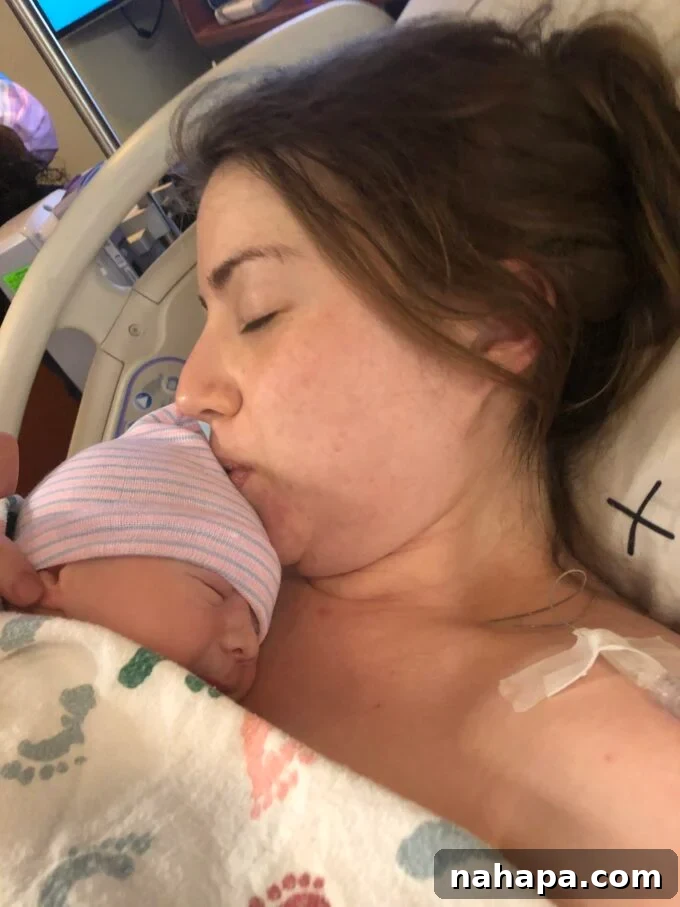
As I cradled him, completely lost in awe and the miracle of his presence, I vaguely noticed the OB meticulously stitching me up. I didn’t even want to inquire about the details, as I was still so numb and couldn’t feel anything. However, I overheard a comment indicating I had sustained a second-degree tear. At that moment, the tear and the stitches held absolutely no significance for me. “Give me all the stitches you want,” I thought. All that truly mattered was that my baby was safe, healthy, and finally, miraculously, united with us on the outside. Every struggle, every pain, every fear faded into insignificance in the face of his perfect little being.
Navigating the Postpartum Journey: Challenges and Unexpected Joys
The postpartum period, I’m still very much immersed in it, even now! The immediate aftermath at the hospital proved to be another challenging chapter. We had to extend our stay for two additional nights, primarily for close monitoring for infection, a necessary precaution given how long my water had been broken. This meant nurses frequently checking my vitals and drawing blood, often in the dead of night, around 2 AM. Coupled with the constant demands of a brand-new baby wanting to nurse tirelessly throughout the night, achieving any meaningful sleep or recovery from my incredibly long and arduous labor was virtually impossible. It was a cycle of exhaustion upon exhaustion.
Then, the true work of parenthood began the moment we returned home – a home that was still under the strictures of lockdown. While we were incredibly grateful for the generosity of family and friends who thoughtfully dropped off meals at our doorstep, the reality of our postpartum experience was vastly different from what we had envisioned. It was just the three of us, navigating the uncharted waters of new parenthood in isolation. The absence of additional, hands-on support during such a vulnerable time made the journey significantly harder than it needed to be.
Beyond the mental and emotional adjustments, my body also had a substantial recovery ahead. I had to heal from labor, allow my stitches to mend, and simultaneously embark on the steep learning curve of breastfeeding. All of this, of course, was punctuated by the relentless cycle of sleepless nights that accompany a newborn. To add another layer of unexpected difficulty, somewhere along the way during labor, I had severely burned my esophagus. I’m still unsure if this was a direct result of the extensive vomiting, or perhaps a side effect of the pain relief and antibiotics administered due to my broken water. Regardless of the cause, even the simple act of drinking water became an intensely painful ordeal, leaving my throat burning. I ultimately required a prescription medication to soothe and heal my esophagus before it finally returned to normal. It was a bizarre and unwelcome complication.
Undoubtedly, having a baby during the initial lockdown presented its unique set of difficulties and anxieties. Yet, surprisingly, amidst the challenges, there emerged numerous profound positives. The enforced isolation gifted us an extraordinary amount of uninterrupted bonding time with our sweet boy. We cherished daily skin-to-skin cuddle sessions, fostering an incredible connection. My milk supply flourished, proving abundant and consistent, and Jett thrived, regaining his birth weight and then some in remarkably record time! While the circumstances of his arrival were utterly unexpected and far from ideal, I will forever treasure those early, intimate days – just Jett, Mommy, and Daddy, forming our tiny, resilient bubble in a world turned upside down.
Reflecting on Future Births: Will I Consider Natural Birth Again?
Daniel and I are still far from 100% certain about whether we will even expand our family with a second child. We feel it’s crucial to successfully navigate Jett’s first year of life, mastering the complexities of infant care and truly understanding the demands of parenthood, before seriously contemplating another pregnancy. As for the question of attempting another natural birth, should we choose to have another baby, I honestly have no idea what my approach would be the second time around. It’s a bridge we will respectfully cross if and when we ever arrive there, with an open mind and heart.
Addressing the Question of Recurrence: Will Prodromal Labor Happen Again?
It’s a valid and frequently asked question. My midwives and the OB team both advised me that while prodromal labor could potentially recur in a future pregnancy, it is by no means a certainty. Their consistent message was a powerful reminder: every birth journey is incredibly unique and unpredictable, even for the same woman. So, while I’ll be aware of the possibility, I won’t necessarily expect it.
The End of Our Story, A Beautiful Beginning
At the core of my being, I firmly believe that everything in life unfolds precisely as it is meant to. There is a divine plan, and a greater power is always in control, guiding our paths even through the most challenging circumstances.
This is undeniably a long, crazy, and profoundly hard story. It is filled with moments of fear, exhaustion, and unexpected turns. But above all, it is *our* story. It is the unforgettable, intense, and ultimately triumphant narrative of how my incredible little boy, Jett, entered this world. And for that reason alone, every single moment of it, every struggle and every victory, renders it an exquisitely beautiful and cherished tale.